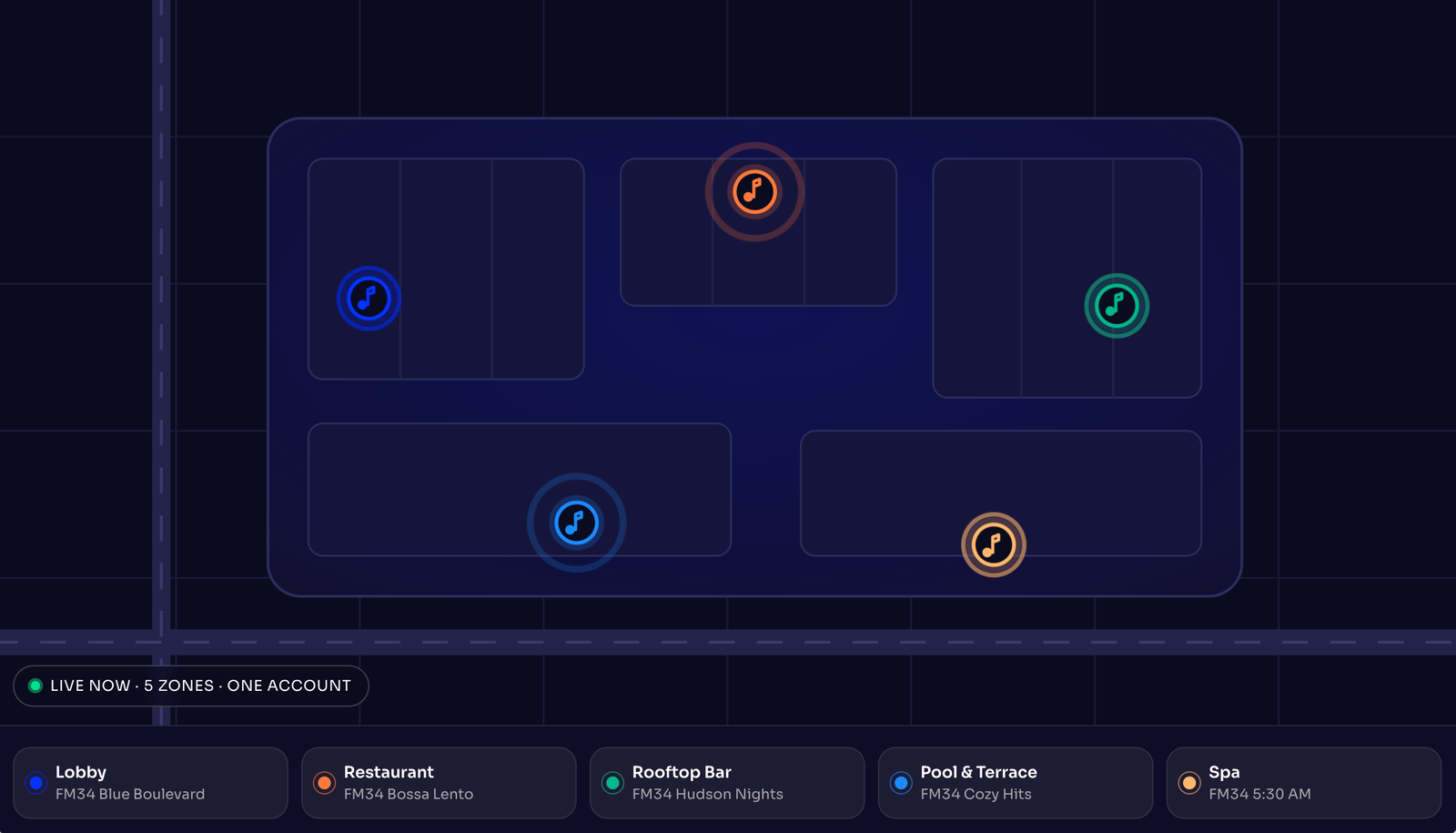
Your terrace at 6pm and your dining room at 6pm are two different businesses. One is loud, sunlit, half-standing, turning tables every forty minutes. The other is seated, dim, and settling in for two hours. Yet most venues feed both from a single output, then spend the evening splitting the difference — music that's slightly too flat for the terrace and slightly too busy for the tables.
That's the problem Sound Profiles solve. From today, SpinLoud lets you assign a distinct profile to each zone in your venue, so you can run different music for different areas of the same venue while keeping one recognisable identity across all of them.
This is not a routing feature. Splitting an audio signal into four zones has been possible for decades with a mixer and enough cable. What's hard — and what nobody has solved well for hospitality — is making four zones sound like four rooms in the same place rather than four unrelated businesses sharing a postcode.
Why different music for different areas of the same venue is an identity problem
When a guest walks from your entrance to your bar to your restroom and back to their table, they're taking a tour of your brand. Every transition is a small judgement: does this still feel like the place I chose?
Get it wrong and the seams show. The classic failure is the restroom — a room that gets whatever the nearest speaker was already playing, or worse, nothing at all, leaving guests with the acoustics of a tiled box. The second classic failure is the terrace treated as an overflow zone, running dining-room music at dining-room energy while the actual atmosphere out there is three times more animated.
The fix isn't "more variety." It's designed relatedness. Rooms should differ in energy while sharing DNA.
A guest should never be able to name what changed between your terrace and your dining room — only notice that one felt brighter.
How Sound Profiles work
Each zone in your SpinLoud account gets its own profile: its own channel or channel blend, its own scheduling, its own SpnSound processing settings tuned to that room's acoustics, and its own SpnMix behaviour for how tracks move into one another.
Crucially, profiles are built as variations on your Brand Sound, not from scratch. When our programmers set up your account, we define the core identity first — the artists, eras, textures and moods that are recognisably yours. Zone profiles are then derived from that core by adjusting a small number of controlled variables. Same family, different temperament.
That means when your Brand Sound evolves — a seasonal refresh, a new direction, a CherryPick request that changes the rotation — every zone moves with it. You're not maintaining four separate music strategies.
The variables we actually adjust
There are only a handful of levers worth pulling. Pull more than that and zones stop being related.
- Tempo band. Not a single BPM, but a working range. A dining room might sit in a relaxed band; the terrace shifts that band upward by a modest step rather than a jump. Large tempo gaps are what make two rooms feel like two venues.
- Arrangement density. How many things are happening at once. Sparse, space-heavy arrangements suit rooms where conversation is the primary sound. Denser, layered production suits rooms where music is competing with clatter and crowd.
- Vocal presence. Instrumental-leaning or vocal-forward. This is the single most effective lever for changing perceived energy without changing the music's character.
- Familiarity ratio. How much recognisable material sits alongside discovery. Higher familiarity works where dwell time is short; more discovery suits rooms where people stay.
- Loudness and tonal shaping. Handled by SpnSound per zone, because a hard-surfaced terrace and a soft-furnished dining room need genuinely different treatment to sound equally good.
The rules that keep zones related
Our programmers work to a simple discipline: adjacent zones move one step, not two. If the dining room is calm and the bar is lively, the corridor or entrance between them shouldn't be either extreme — it should bridge.
We also hold at least one variable constant across every zone. Usually that's era and production aesthetic. If your Brand Sound leans warm, analogue, mostly post-2010 with a soul thread running through it, that stays true in the restroom and on the terrace. Only energy moves.
And we cap the total spread. A venue with five zones doesn't need five wildly different atmospheres; it needs a gentle gradient from its quietest room to its most animated one.
What this looks like in practice
The terrace carries the highest energy in most venues: brighter tone, upward tempo band, higher familiarity, denser arrangements to hold up against street noise and open air. SpnSound compensates for the lack of reflective surfaces so the music doesn't thin out.
The dining room sits lower in tempo and density, with more instrumental weight and a higher discovery ratio — people are here longer, so repetition is the enemy. SpnMix transitions run longer and softer; nothing should punctuate a conversation.
The bar typically runs the widest scheduled arc — closest to the dining room early, closest to the terrace late. This is where smart scheduling earns its keep.
The restroom is the zone most venues forget and guests most consistently notice. It wants presence and privacy: enough music to mask, low enough to feel considerate, and unmistakably the same brand as the room they just left.
For multi-location operators, zone profiles are managed alongside everything else in the dashboard, so a five-site group with four zones each isn't twenty problems — it's one Brand Sound with a consistent set of variations.
Getting started
If your account already has multiple zones configured, your programmer can build profiles for them; if you're running a single output today and know some rooms are being underserved, a walkthrough of the space is usually all it takes to map out where the gradient should sit.
Most venues are surprised by how little needs to change. The terrace was never asking for different music — just a slightly different version of the same idea.